ARCHIVES: It's been a busy few weeks, so I'm pulling today's post from my college paper archives. I wrote the following as a theology paper my junior year - turns out I've been analyzing and discussing the roles of men and women in relation to the family for well over a decade. I hope it doesn't bore you too much.
 |
| Our Tridentine High Mass Wedding. |
In the very first chapter of Genesis, God creates man and woman to be companions who
will together populate the earth and subdue it. They were created equal with different duties to
perform within the family. The man is the head of the house, the protector and provider of the
family, while the woman is the heart of the home, the nurturer and homemaker. The creation of a
family is not possible without both the husband and the wife. The husband’s role is the more
external of the two insofar as it is he who must work to support his wife and children as well as
protect them from danger. It is the father who goes out each day and earns the income by which
he provides for his family’s livelihood. This more external role is depicted in the image of the
father as the head of the household. It is the head which makes the decisions which aid the rest
of the body as does the husband whose decisions affect the life of his family. The wife’s role, on
the other hand, is more internal insofar as it is she who cares for the home and the children. To
the wife is entrusted the care of the house, keeping it clean and peaceful for the return of the
husband from his work providing. It is she who brings the children into the world and from her
that the children first learn the most basic lessons in life. Her more internal role is epitomized in
the characterization of the wife as the heart of the home. Just as the heart controls the emotions,
the ups and downs of the body, so, too, does the wife handle the innumerable outbursts and
disagreements as well as the example of how truly to show love to one another. Thus, just, as a
body cannot function without both an head and an heart, only through both the husband and the
wife is the family unit able to function. The roles of the husband and wife complement each
other. Both roles are equally important although they are most certainly different. It can be seen,
thus, that both the husband and the wife have unique duties within the family unit as the head
and the heart which work together to bring the family towards its earthly perfection and its
heavenly goal of eternal life.
The role of the husband is that of protector and provider for his family, the head of the
household. In his letter to the Ephesians, St. Paul clearly lays forth the essence of this duty:
Husbands, love your wives, as Christ loved the church and gave himself up for her, that
he might sanctify her, having cleansed her by the washing of water with the word, that he
might present the church to himself in splendor, without spot or wrinkle or any such
thing, that she might be holy and without blemish. He who loves his wife loves himself.
For no man ever hates his own flesh, but nourishes and cherishes it, as Christ does the
church, because we are members of his body. (Eph. 6:25-30)
The husband is to love his wife as Christ loved the church; that is, he is meant to die to himself in
order that she might live. This sacrifice of self is accomplished by the husband in his efforts to
provide for his family and protecting them from all harms both material and immaterial. It is
explained, too, by Pope John Paul II (JPII) thus:
A man is called upon to ensure the harmonious and united development of all the
members of the family: he will perform this task by exercising generous responsibility for
the life conceived under the heart of the mother, by a more solicitous commitment to
education, a task he shares with his wife, by work which is never a cause of division in
the family but promotes its unity and stability, and by means of the witness he gives of an
adult Christian life which effectively introduces the children into the living experience of
Christ and the Church. Familiaris Consortio.
Generally speaking, this simply means that God entrusts the husband and father with a very
specific and special task of caring for and defending his family, most especially through his labor
to support them. This trust is best epitomized by St. Joseph and the Holy Family, as JPII says,
“Work was the daily expression of love in the life of the Family of Nazareth.” Redemptoris Custos. St. Joseph
labored hard each day in order to provide for his wife, the Virgin Mary, and Christ, the Son of
God, both of whom had been entrusted to his care by God. So, too, must the husband strive as he
demonstrates his love for his family. Concerning the protection of his family, by far the most
important way in which a man does this is through being present in his children’s lives. JPII
states, “Love for his wife as mother of their children and love for the children themselves are for
the man the natural way of understanding and fulfilling his own fatherhood. . . . The absence of a
father causes psychological and moral imbalance and notable difficulties in family
relationships.” Familiaris Consortio. It is from the father that sons will learn how to treat women properly and from
whom daughters will learn how they should expect to be treated by men. Without a father, or at
the very least a father-figure, the children are less likely to develop these all important habits and
expectations, leading to a decline of morality and moral standards. He is the ultimate authority
in the discipline of the household. Thus, it is the role of the husband and father to protect and
provide for his family, depicted as the head of the house.
 |
| Taking care of the house and making sure my husband and future family have a warm, clean, and inviting home is one of the greatest joys of my vocation as a wife and (hopefully) mother. |
The role of the wife is that of homemaker and mother. To her is entrusted the care of the
home and raising the young children. G. K. Chesterton speaks of the woman’s work saying, “A
woman’s function is laborious, but because it is gigantic, not because it is minute.” What's Wrong With the World. Chesterton’s
statement easily portrays the vast extent of a woman’s role in the home. Her immediate role as a
wife is caring for the house, ensuring that her husband has a pleasant place to which he may
return after a long day working to provide for her. This may seem like a rather simple task, and
perhaps it is, but when the wife becomes a mother, her most important and difficult task begins.
This is the task of bearing and raising the children from the moment of their conception through
their most innocent years. Dee Jepsen says, “Women have nurturing and nesting instincts. It is a
natural thing for women to desire to make a home.” Women: Beyond Equal Rights. This, then, is the other reason for women to
be the homemakers, that they may create a home wherein they may raise their children. Their
maternal instinct is imprinted upon their very souls as women although there are some who will
choose other ways of fulfilling it such as the consecrated or religious life. For those women,
however, who do marry and become wives and mothers, their highest fulfillment is in raising
their children and caring for their home, making it pleasant for their family. A mother’s role in
her children’s lives is especially important. Jepsen speaks of this saying, “Children need their
mothers. Children need time with their mothers. The bonding and emotional ties that develop
between them affect children’s personalities, attitudes, and values--greatly influencing the
shaping of their character.” Id. The mother has the greatest amount of influence over the children
during their most impressionable years. It is the mother who most forms the morality of her
children, the future leaders of the world. It is fitting to portray the wife and mother as the heart
of the home. Just as the heart understands and explains the emotions of the body so too it is she
who understands the emotions of all the family members, doing her best to promote an
harmonious household. Thus, the role of the wife is that of homemaker and mother, best
exemplified in the analogy of the woman as the heart of the home.
Together, then, the husband and the wife are the binding force of the family, the head and
the heart of one body. Pope Pius XI speaks of their bond in his encyclical Casti Connubii:
This mutual molding of husband and wife, this determined effort to perfect each other,
can in a very real sense, as the Roman Catechism teaches, be said to be the chief reason
and purpose of matrimony, provided matrimony be looked at not in the restricted sense as
instituted for the proper conception and education of the child, but more widely as the
blending of life as a whole and the mutual interchange and sharing thereof. Casti Connubbii.
Looking at marriage in the full sense, it is the husband and wife’s first duty to draw each other
closer to Heaven and eternal life with God and, secondarily, to conceive, bear, and raise children
in good morals. Man and woman, husband and wife, were “made to complement each other. To
‘complement’ means to complete or make perfect. That is what man and woman do for each
other - spiritually, psychologically, physically, and sexually.” The Power of the Christian Woman. The distinct roles of the husband
and wife complement each other. Both roles, though different, are necessary for the completion
of the family unit. As JPII states, “Above all it is important to underline the equal dignity and
responsibility of women with men. This equality is realized in a unique manner in that reciprocal
self-giving by each one to the other and by both to the children which is proper to marriage and
the family.” Familiaris Consortio. It is through their specific duties that men and women are able, through union in
marriage, to develop a family. Both of their roles are equally important. Just as a body cannot
function without both head and heart, so too the family unit cannot function without both the
husband and the wife. It must have both in order to be complete. JPII says, “The future of
humanity passes by way of the family.” Familiaris Consortio. Without the family, the human race will cease to exist.
It is, thus, crucial that both the father and the mother fulfill their specific roles within the family
as they raise their children to live in the truth and follow the good way on their pilgrimage to
Heaven and eternal life. It is, therefore, through both the head and the heart, the husband and
the wife, that their respective roles are fully completed as their complement each other, working
together for ultimate union with God.

In summarization, the husband and the wife both have unique roles to perform within the
family. The husband is the head of the house as he provides for and protects his wife and
children. Through his work the husband lays forth himself in self-sacrifice out of love for his
wife and family. He must also be a firm example for his children, leading a moral life which they
may admire and imitate. The wife is the heart of the house, caring for the home and the children.
She cares for the home, ensuring the comfort of her husband when he returns from work, thus
showing her love for him. It is also the wife and mother who raises the children through their
most critical years, ensuring that they receive a good moral understanding. She, too, must set an
example of morality for her children to imitate. Together, the husband and wife complement
each other through their individual roles, aiding each other on their journey to Heaven and
eternal life with God. It is also only through the union of man and woman in marriage that
children may be procreated and humanity continued. Together the husband and wife must raise
their children in the truth. It is seen, therefore, that both the husband and the wife have specific
and different roles within the family unit which are equal in importance and without which the
human race could not continue except for the complementarity of their roles. Truly, the husband
is the head and the wife the heart of the body of their family
 First, "You should've asked." Now, this question is not something I ask . . . I don't tend to ask for help. I tend to take care of ALL the things myself until I burn out and explode . . . like the pot of food on the stove. And granted, there is a part of me that wishes people would just help out without my asking. So women tend to be the managers of the household . . . as is their rightful place. After all, that's our role - to raise the family and keep things running while our husbands are out providing for us. And it is a beautiful role. (So here's my first disagreement . . . men are not underlings in the household. They are members and partners. They just have a different role in the household.) Besides, the managing role tends to come naturally to the wife in matters of the household . . . groceries; chores; bills; etc.
 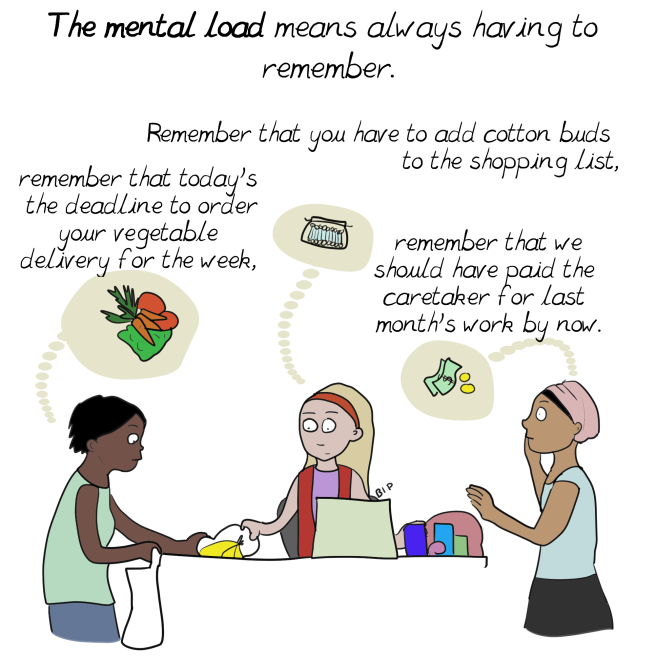 Anyways, the fact that women of the household are constantly managing and thinking of all the things means that we have a mental load that never disappears . . . we ALWAYS have to remember. Men, this post is NOT intended to shame you or make you feel like you're not doing everything you're supposed to. Rather, it's meant to explain (hopefully) a little more clearly why your wives may be more exhausted than you expect when you get home. And also to keep you from showing up and asking why we're so tired when all we did was stay home all day. Don't say that.
  Third, I completely and utterly disagree with the insinuation that conditioning society to view women as mothers and wives and men as heroes, aka workers, is wrong. This is the way it SHOULD BE. Rather, our society today is conditioned to think that women should do it ALL . . . career; family; household. And that's where the discrepancy and frustration comes from. Because women are essentially asked to handle two full-time jobs (career and home) while men still only have the one. Now, if you choose (or need) to have a dual-income home, then you and your spouse should communicate, discuss, and adapt as need be to alleviate stress. But essentially, the solution to this "mind load" issue is about both parties gaining a better understanding of the demands laid upon each other and how they can help each other. After all, marriage is a partnership . . . and it will only succeed if both parties work together.


